
What 30 Years of Ambidexterity Research Actually Tell Us and What We Still Don’t Know
The Dilemma That Won’t Go Away
In 1997, Clayton Christensen asked a question that still haunts boardrooms: why do successful companies fail? Not because they’re incompetent, but because they’re too good at what they already do. They perfect their existing products, delight their existing customers, optimize their existing processes and get blindsided by newcomers who play a different game.
The question wasn’t rhetorical. It was existential. And it has only grown more urgent. Kodak knew about digital photography. Nokia knew about smartphones. Blockbuster had the chance to acquire Netflix for $50 million. They didn’t fail because they lacked information or intelligence. They failed because the very capabilities that made them great prevented them from becoming something new.
Christensen called it the Innovator’s Dilemma. His core argument was counterintuitive: it is precisely “good” management: listening to customers, investing in proven products, pursuing predictable growth. That leads to failure in the face of disruptive change. The academic community offered a more precise term: the failure of organisational ambidexterity, the inability to simultaneously exploit what works today and explore what might work tomorrow.
So 30 years from this problem formulation: has this problem been solved?
What the Research Actually Shows
The short answer is: yes, some organisations have navigated the tension and managed to embed ambidexterity. And we have a surprisingly rich body of research that explains why they succeeded. The longer answer is: we still don’t know enough about how to replicate their success systematically.
Here is what three decades of rigorous research tell us and the picture that emerges is both encouraging and humbling:
Individual ambidexterity exists and has specific enablers. Mom, van den Bosch, and Volberda (2009) found that individual ambidexterity depends on decision-making authority, cross-functional participation, and network connectedness. Joseph et al. (2023) identified 29 factors that enhance and 4 that inhibit individual ambidexterity. Hill, Tedards, and Wild (2026) operationalised this through the ABC framework: Architects who envision, Bridgers who connect, and Catalysts who activate. The people who drive ambidexterity are identifiable, in theory.
Teams are where ambidexterity lives or dies. Amy Edmondson’s work (1999, 2018), validated at scale by Google’s Project Aristotle, established that psychological safety is the single most important factor for team effectiveness. Teams without it cannot explore, they can only comply. What makes this insight powerful is that psychological safety is measurable . It is one of the few ambidexterity enablers for which validated instruments already exist. What we don’t yet know well is how to build the bridge from psychological safety scores to ambidexterity outcomes.
Business units face the sharpest structural choices. O’Reilly and Tushman (2004) argued for structural ambidexterity: separate exploration units, integrated at the top. Gibson and Birkinshaw (2004) found that contextual ambidexterity, creating the conditions for individuals to toggle between exploitation and exploration within a single unit, can be equally effective. Kotter (2014) proposed a dual operating system: a hierarchy for execution and a network for innovation. The right approach depends on context and the business unit is where the tension between these models is most tangible. Janssen et al. (2012) showed that ambidexterity dynamics at the business unit level are distinct from both team-level and organisation-level dynamics, particularly in multi-unit firms.
The organisational level is where the balance becomes visible. O’Reilly and Tushman studied ambidextrous organisations for over two decades. Their findings are striking: organisations using ambidextrous structures succeeded in breakthrough innovation at rates far exceeding those using traditional designs. More recently, empirical analysis published in Nature (2025) found that the optimal exploration–exploitation balance is remarkably close to 50/50, suggesting that organisations need to invest in the future almost as much as they invest in the present. (Though the optimal ratio almost certainly varies by industry: a pharma company navigating 15-year development cycles faces a very different balance than a software company shipping weekly. The 50/50 finding is a useful anchor, not a universal prescription.) The question is how to know, in real-time, where you stand.
Governance sets the boundary conditions. An emerging body of research is making the case that ambidexterity is not just an operational capability but a governance responsibility. Oehmichen et al. (2017) found that board composition directly affects firm ambidexterity, boards with more diverse experience backgrounds enable greater exploration. Hearl (2025) recently proposed ambidexterity as a core board capability, arguing that governance committees should actively balance exploration and exploitation mandates. When the board governs only for short-term exploitation, the organisation’s structural ambidexterity efforts are undermined from the top.
The ecosystem extends ambidexterity beyond the firm. Increasingly, research recognises that ambidexterity is not purely an internal capability. Organisations that participate in innovation ecosystems through partnerships, open innovation platforms, and collaborative research, can access exploration capabilities they could never build alone. Istala et al. (2024) found evidence of “collective ambidexterity” in digital service ecosystems, where organisations balance exploration and exploitation across institutional boundaries rather than only within them. For many firms, the ecosystem level may be where the most consequential ambidexterity decisions are made.
Cutting across all levels: leadership, networks, and culture.
While the levels above describe where ambidexterity lives, three cross-cutting mechanisms determine how it works:
Leadership behaviour is the strongest lever. Rosing, Frese, and Bausch (2011) identified what they called ambidextrous leadership: the capacity to toggle between “opening behaviours” (encouraging experimentation, accepting mistakes, broadening search) and “closing behaviours” (setting guidelines, correcting errors, driving efficiency). This temporal flexibility, knowing when to open and when to close, turns out to be the single most important predictor of team-level innovation. Specifically, this means the ability to tolerate the “heat” of conflicting priorities between exploration and exploitation units, to resist the organisational pressure to resolve the tension prematurely in favour of what’s working today. It’s also one of the hardest things to observe, let alone measure.
Innovation travels through networks, not org charts. Rob Cross (2021) found that a small fraction of employees, often as few as 3–5%, drives the majority of change adoption. Burt’s (2004) structural holes research showed that people who bridge disconnected groups generate better ideas. Granovetter’s (1973) “weak ties” insight revealed that novel information travels through loose connections, not tight circles. The implication: your innovation capacity is not a function of your R&D budget. It’s a function of how your people are connected at every level from team to ecosystem.
Culture is the operating system. Wang and Rafiq (2014) showed that ambidextrous organisational culture, distinct from structure, is a significant predictor of new product innovation. Gibson and Birkinshaw’s (2004) contextual ambidexterity is, at its core, a cultural argument: that the right behavioural context (combining discipline with stretch, trust with support) enables individuals to allocate time between exploitation and exploration without structural separation. Culture is not a level to be measured in isolation it’s the medium through which all levels interact.
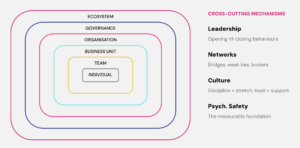 Figure 1: Ambidexterity is a system of nested levels — from individual to ecosystem — shaped by cross-cutting mechanisms that operate across all of them.
The Gap Between Knowing and Doing
This is an impressive body of knowledge. Three decades of research from Harvard, Stanford, MIT, INSEAD, and LMU Munich. Validated frameworks. Empirical evidence. Role model companies, like Amazon, Siemens, ING Bank, Haier, Mastercard, Microsoft, and others, that have actually pulled off the transition.
And yet, most organisations still can’t do it. Pfeffer and Sutton (2000) called this the “Knowing-Doing Gap”: the persistent failure of organisations to translate knowledge into action. Nowhere is this gap wider than in ambidexterity.
Why? We believe there are three reasons:
First, ambidexterity is multi-level. It lives simultaneously in individual capabilities, team dynamics, business unit strategies, organisational structures, and governance decisions — shaped by cross-cutting forces like leadership behaviour, psychological safety, network structure, and culture. It’s not one thing you can optimise. It’s a system. And systems are hard to see from inside.
Second, the research insights are mostly retrospective. We know what successful ambidextrous organisations look like after the fact. We know what Kodak and Nokia got wrong after they failed. What organisations need is prospective intelligence: early signals that their exploration–exploitation balance is drifting, that their networks are calcifying, that their leadership is closing when it should be opening.
Third, no single organisation can calibrate itself. Your psychological safety score is 3.8. Is that good? Your internal mobility rate is 12%. Is that high or low for your industry? Your exploration–exploitation project ratio is 22:78. Is that healthy or dangerous? Without external reference points, internal measurement is like having a thermometer but no temperature scale.
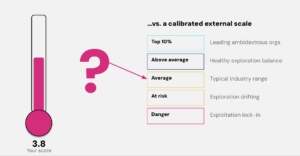
Figure 2: Internal scores need external benchmarks to become meaningful. A thermometer without a temperature scale is just a number.
What If We Could Actually Measure It?
This is where things get interesting. Because while the Knowing-Doing Gap is real, the pieces to close it are not entirely missing. They’re scattered.
The research points to specific constructs that can be measured: leadership opening/closing behaviours, psychological safety, team learning orientation, network bridging density, individual exploration capacity, board-level exploration mandates. For many of these, validated instruments exist. What doesn’t exist yet is the integrated measurement system that connects them across levels, from individual through team, business unit, and organisation to governance, and the comparative benchmarks that give the measurements meaning.
Imagine you could track, over time, how your organisation performs across the dimensions that research associates with successful ambidexterity, from individual capability through teams and business units to organisation-wide governance, shaped by leadership behaviours, psychological safety, network structure, and culture, and compare that trajectory against organisations that have navigated similar transitions. Not a one-time audit. A continuous feedback loop that helps you see whether your interventions are working, whether your change programmes are reaching the right people, whether your culture is shifting in the direction you intend.
That feedback loop doesn’t exist today. But we believe the research foundation is strong enough to start building it.
From Research to Practice: The Missing Infrastructure
The challenge is not just measurement. It’s the infrastructure that makes measurement meaningful.
A single organisation measuring its own ambidexterity is useful. But it’s also limited. You can track improvement over time, but you cannot calibrate against peers. You cannot distinguish between “we’re getting better” and “everyone is getting better.” You cannot identify whether your exploration investment is appropriate for your industry or competitive position. And you cannot learn from others’ transitions without access to their data.
This is the fundamental insight behind People Data Collaboration: the idea that workforce intelligence becomes exponentially more valuable when it can be compared, benchmarked, and learned from across organisations — while preserving privacy and data sovereignty. Concretely, this means federated analytics (data never leaves the organisation), depersonalisation, anonymisation and differential privacy (individual employees are never identifiable), and European data infrastructure standards (Gaia-X). No raw people data is ever shared — only anonymised, depersonalised, aggregated patterns that enable cross-company comparison. The same principle that powers clinical trials in medicine (no hospital draws conclusions from its own patients alone) could power organisational learning at a different scale.
But we want to be clear: this is a hypothesis, not a claim. We believe that connecting the best ambidexterity research to real-world people data, across multiple organisations, can create the feedback infrastructure that has been missing. We believe the constructs identified in the research — the leadership behaviours, the psychological safety levels, the network structures, the governance conditions, the individual enablers — can be operationalised into measurement approaches that help organisations see their ambidexterity trajectory. But we have not yet proven this.
A Virtuous Cycle: Researchers Meet Practitioners
What excites us most about this space is not the technology or the data architecture. It’s the opportunity to create something that doesn’t exist yet in the ambidexterity field: a virtuous cycle between the best researchers and the best practitioners.
Today, academic research on ambidexterity follows the traditional path: study organisations retrospectively, publish findings, hope practitioners read them. Practitioners, in turn, design interventions based on intuition, best-practice benchmarks from consulting firms, and hope. The feedback loop between research and practice is slow, noisy, and largely one-directional.
What if it didn’t have to be?
What if the most innovative organisations, the ones actively investing in ambidexterity transitions, could contribute people data in a privacy-preserving way to a collaborative research ecosystem? What if researchers could test their hypotheses against real-time organisational data instead of retrospective case studies? What if the insights from that research flowed back to practitioners as actionable intelligence, calibrated benchmarks, early warning signals, prediction models and evidence about which interventions actually work?
This is the cycle we want to build. Not a product that claims to have the answers, but a platform that accelerates the search for them. A place where research meets reality, where hypotheses get tested, where the best thinking about organisational ambidexterity meets the best practice of organisations that are actually trying to achieve it.
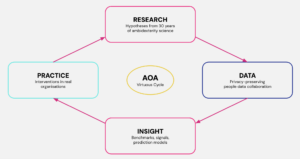
Figure 3: The AOA Virtuous Cycle — each iteration makes the intelligence more precise and the evidence more actionable.
AOA: Ambidextrous Organisation Acceleration
This is the idea behind AOA — Ambidextrous Organisation Acceleration. Not a finished Data Product, yet. A collaborative research-to-practice programme, built on the Tapir People Data Collaboration platform alongside our work on Evidence-Based Wellbeing and Psychological Safety for Innovation Data Products. The Tapir Platform and Community allows for privacy-preserving data collaboration without ever losing control or privacy about any input data. When “data alienation” is impossible, and data products are created and owned jointly by the best researchers and the best enterprises, data network effects and feedback loops are unleashed to accelerate the whole data product community in tandem.
Our Point of View:
The Innovator’s Dilemma is solved in theory. Thirty years of research have identified the capabilities, structures, and behaviours that distinguish ambidextrous organisations. What’s missing is not the knowledge, it’s the infrastructure to apply and operationalize it: real-time measurement and treatments across nested levels (from individual to ecosystem), cross-organisational calibration, and a feedback loop between research and practice.
The Problem:
Organisations invest in innovation programmes, transformation initiatives, and dual operating systems without the measurement infrastructure to know whether they’re working. Leaders are flying blind on the one capability that most determines long-term survival. The Knowing-Doing Gap persists because there is no feedback loop between ambidexterity research and ambidexterity practice.
What Makes This Different:
No single organisation can generate the comparative intelligence needed to calibrate its ambidexterity journey. And no academic institution can validate its models without access to real-world organisational data at scale. AOA is designed to bridge this gap by creating a space where innovative organisations and leading researchers work together to turn the best ambidexterity science into operational capability.
Our Commitment — Hypotheses, Not Certainties:
We want to be transparent. The measurement approaches, the multi-level model (from individual through team, business unit, and organisation to governance and ecosystem), the signals and constructs we’ve identified in the research, these are hypotheses. Well-grounded hypotheses, backed by decades of peer-reviewed work, but hypotheses nonetheless. The AOA programme is designed to test them: to find out what actually works in practice, what needs refinement, what we’re missing. We don’t claim to have solved the Innovator’s Dilemma. We believe the research shows how it can be solved and we’re building the infrastructure to prove it, together.
Who This Is For
AOA is not for every organisation. It is for the ones that are already investing in ambidexterity, running innovation programmes, experimenting with dual operating systems, redesigning their leadership development, and want three things they currently don’t have:
- Direction: Are we focusing on the right levers? Research identifies leadership behaviour, psychological safety, network structure, governance, and individual capability as key drivers. But which matters most in our specific context?
- Feedback: Are our interventions working? When we invest in psychological safety training, or restructure for ambidexterity, or develop bridging networks across business units. Is anything actually changing? And how fast, compared to similar organisations?
- Acceleration: How can we learn from organisations that are further along? What patterns emerge from comparative data that no single company could see in isolation?
If you recognise these questions, you’re exactly who we’re looking for. Not as a customer of a finished product, but as a co-creator of a new kind of organisational intelligence.
The Ambidexterity Tax
We should not romanticise ambidexterity. It has a price and pretending otherwise would undermine the honest framing we’ve tried to maintain throughout this article.
Pursuing exploration and exploitation simultaneously creates massive cognitive dissonance for leaders and operational friction between units. The exploration team wants freedom, resources, and patience. The exploitation team wants discipline, efficiency, and predictability. Both are right. And holding that tension, day after day, quarter after quarter, is exhausting. Without clear governance structures, psychological safety, and a shared understanding of why the tension exists, ambidexterity doesn’t lead to innovation. It leads to organisational burnout.
This is precisely why measurement matters — and why we frame AOA as a tool for steering tension, not maximising it. The goal is not to push organisations into permanent ambidexterity overdrive. It is to give them the visibility to know when the tension is productive and when it has tipped into dysfunction and the comparative intelligence to calibrate their response. The ambidexterity tax is real. The question is whether you’re paying it blindly or managing it deliberately.
The Question Behind the Question
We started with the Innovator’s Dilemma. Has it been solved?
The research says: in principle, yes. We know what ambidextrous organisations look like, what their leaders do differently, how their teams operate, how their networks are structured, how their boards govern. The evidence from Harvard, Stanford, INSEAD, and LMU Munich is substantial.
But in practice? Most organisations still can’t close the gap between knowing and doing. They lack the measurement infrastructure, the external calibration, and the feedback loops that would turn ambidexterity from a concept they understand into a capability they can build.
Building that infrastructure is what we’re setting out to do, not alone, but together with organisations that share ambition and researchers who share curiosity. A virtuous cycle between the best science and the best practice, accelerating both.
If that sounds like a journey worth joining, please express your interest in the initiative here:
This article synthesises insights from academic sources across organisational ambidexterity, innovation leadership, psychological safety, and network science. A detailed companion paper with the full research, prediction model hypotheses, and role model company analysis is available on request.
Sources and References
Organisational Ambidexterity
- March, J.G. (1991). Exploration and exploitation in organizational learning. Organization Science, 2(1), 71–87. https://doi.org/10.1287/orsc.2.1.71
- O’Reilly, C.A. III & Tushman, M.L. (2004). The ambidextrous organization. Harvard Business Review, 82(4), 74–81. https://hbr.org/2004/04/the-ambidextrous-organization
- O’Reilly, C.A. III & Tushman, M.L. (2013). Organizational ambidexterity: Past, present, and future. Academy of Management Perspectives, 27(4), 324–338.
- O’Reilly, C.A. III & Tushman, M.L. (2021). Lead and Disrupt: How to Solve the Innovator’s Dilemma (2nd ed.). Stanford University Press.
- Gibson, C.B. & Birkinshaw, J. (2004). The antecedents, consequences, and mediating role of organizational ambidexterity. Academy of Management Journal, 47(2), 209–226.
- Simsek, Z. (2009). Organizational ambidexterity: Towards a multilevel understanding. Journal of Management Studies, 46(4), 597–624. https://onlinelibrary.wiley.com/doi/abs/10.1111/j.1467-6486.2009.00828.x
- Raisch, S. & Birkinshaw, J. (2008). Organizational ambidexterity: Antecedents, outcomes, and moderators. Journal of Management, 34(3), 375–409.
- Nature Humanities and Social Sciences Communications (2025). Empirical analysis of the technological exploration–exploitation balance. https://www.nature.com/articles/s41599-025-04476-w
The Innovator’s Dilemma and Change Leadership
- Christensen, C.M. (1997). The Innovator’s Dilemma: When New Technologies Cause Great Firms to Fail. Harvard Business School Press.
- Christensen, C.M., Raynor, M.E. & McDonald, R. (2015). What is disruptive innovation? Harvard Business Review, December 2015. https://hbr.org/2015/12/what-is-disruptive-innovation
- Kotter, J.P. (2014). Accelerate: Building Strategic Agility for a Faster-Moving World. Harvard Business Review Press.
- Pfeffer, J. & Sutton, R.I. (2000). The Knowing-Doing Gap: How Smart Companies Turn Knowledge into Action. Harvard Business School Press.
- Rogers, E.M. (2003). Diffusion of Innovations (5th ed.). Free Press.
Ambidextrous Leadership
- Rosing, K., Frese, M. & Bausch, A. (2011). Explaining the heterogeneity of the leadership-innovation relationship: Ambidextrous leadership. The Leadership Quarterly, 22(5), 956–974.
- Hill, L.A., Brandeau, G., Truelove, E. & Lineback, K. (2014). Collective Genius: The Art and Practice of Leading Innovation. Harvard Business Review Press.
- Hill, L.A., Tedards, E. & Wild, J. (2026). Genius at Scale: How Great Leaders Drive Innovation. Harvard Business Review Press.
- Hagel, J. III & Brown, J.S. (2017). Great businesses scale their learning, not just their operations. Harvard Business Review. https://hbr.org/2017/06/great-businesses-scale-their-learning-not-just-their-operations
Psychological Safety
- Edmondson, A.C. (1999). Psychological safety and learning behavior in work teams. Administrative Science Quarterly, 44(2), 350–383.
- Edmondson, A.C. (2018). The Fearless Organization: Creating Psychological Safety in the Workplace for Learning, Innovation, and Growth. John Wiley & Sons.
- Google re:Work (2015). Guide: Understand team effectiveness. https://rework.withgoogle.com/guides/understanding-team-effectiveness/
- Englmaier, F., Castro, S. & Guadalupe, M. (2022). Psychological safety and team performance: A large-scale causal field experiment. LMU Munich–INSEAD Working Paper.
Network Science
- Granovetter, M.S. (1973). The strength of weak ties. American Journal of Sociology, 78(6), 1360–1380.
- Burt, R.S. (2004). Structural holes and good ideas. American Journal of Sociology, 110(2), 349–399.
- Cross, R. (2021). Beyond Collaboration Overload: How to Work Smarter, Get Ahead, and Restore Your Well-Being. Harvard Business Review Press.
Individual Ambidexterity
- Mom, T.J.M., van den Bosch, F.A.J. & Volberda, H.W. (2009). Understanding variation in managers’ ambidexterity: Investigating direct and interaction effects of formal structural and personal coordination mechanisms. Organization Science, 20(4), 812–828.
- Joseph, J. et al. (2023). Decoding employee ambidexterity: 29 enhancing and 4 inhibiting factors. Heliyon. https://doi.org/10.1016/j.heliyon.2023
Governance, Business Unit, and Ecosystem Ambidexterity
- Oehmichen, J. et al. (2017). Boards of directors and organizational ambidexterity in knowledge-intensive firms. Journal of Human Relations, 70(7), 861–888.
- Hearl, A. (2025). Ambidexterity in the boardroom: A core capability to improve effectiveness. Organizational Dynamics.
- Janssen, J. et al. (2012). Ambidexterity and performance in multiunit contexts: Cross-level moderating effects of structural and resource attributes. Strategic Management Journal, 33(11), 1286–1303.
- Istala, M. et al. (2024). Collective ambidexterity in the public sector: Collaborating towards innovativeness and efficiency in digital service ecosystems. Government Information Quarterly.
- Wang, C.L. & Rafiq, M. (2014). Ambidextrous organizational culture, contextual ambidexterity and new product innovation. British Journal of Management, 25(1), 58–75.
Role Model Companies — Selected Sources
- O’Reilly, C.A. III, Harreld, J.B. & Tushman, M.L. (2009). Organizational ambidexterity: IBM and emerging business opportunities. California Management Review, 51(4).
- HBR (2020). How Apple is organized for innovation. Harvard Business Review. https://hbr.org/2020/11/how-apple-is-organized-for-innovation
- McKinsey (2015). ING’s agile transformation. https://www.mckinsey.com/industries/financial-services/our-insights/ings-agile-transformation
- Corporate Rebels. Haier’s RenDanHeYi model. https://www.corporate-rebels.com/blog/10-questions-about-haiers-rendanheyi-model-answered
- INSEAD. Who killed Nokia? Nokia did. https://knowledge.insead.edu/strategy/who-killed-nokia-nokia-did
- MIT Sloan. The real lessons from Kodak’s decline. https://sloanreview.mit.edu/article/the-real-lessons-from-kodaks-decline/
- BCG (2023). Why ambidexterity in business needs to evolve. https://www.bcg.com/publications/2023/why-ambidexterity-in-business-needs-to-evolve
 People Strategy in an Age of Evidence-Based Wellbeing
Andreas Fauler
Business
What this is about
Discover why the Innovator’s Dilemma still persists and how organisations can finally turn ambidexterity from theory into measurable, actionable capability.Related Posts



Share Story!
Andreas Fauler
Business